Can you believe how hassle-free the disinfector assembly line is?
Intelligent Assembly Line for Disinfection Machines: The Quality Engine of Precision Manufacturing
In modern public health systems, disinfection machines are critical equipment to block pathogen spread. The precision and reliability of their manufacturing process directly determine the protective effectiveness of end products. Our intelligent assembly line for disinfection machines is an industrial solution built around this core demand. Through modular process design and intelligent management, it elevates quality across the full production chain, from parts to complete machines.
1. Production Line Architecture: Modular Spatial Layout
The assembly line uses an open modular architecture, flexibly combined from standardized workstation units. The main line consists of four functional modules: pre-treatment area, core component assembly area, complete machine joint debugging area, and final inspection & packaging area.
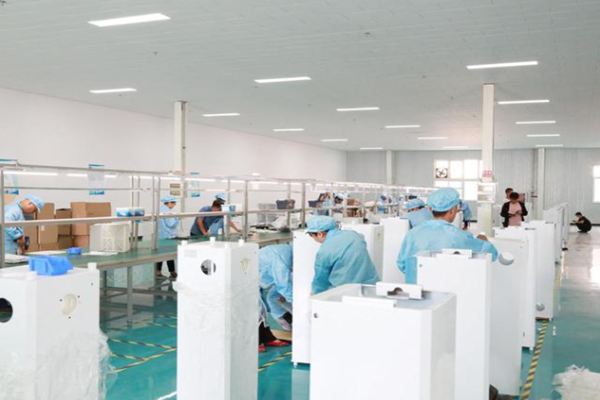
Intelligent logistics channels enable seamless connection between areas. As shown in the figure, station spacing is ergonomically optimized. This ensures operator comfort and reserves expansion interfaces for automated equipment.
The floor uses anti-static epoxy material, paired with a constant temperature, humidity-controlled air purification system. This protects precision electronic components from environmental interference during assembly.
2. Process Flow: Lean Assembly Logic
Disinfection machine assembly follows the lean principle: “from the inside out, heavy first, light later”.
Initial Process: Core Module Pre-Installation
This stage focuses on pre-installation of core functional modules. It includes precise positioning of UV lamp arrays, airtightness testing of atomization systems, and program burning for control motherboards. After pre-debugging at independent workstations, components are transferred to the main line via AGV trolleys for body integration.
Middle Process: Structural Part Modular Assembly
After laser cutting and CNC bending, the sheet metal shell is accurately connected to internal functional modules. Electric tightening tools with controllable torque ensure mechanical consistency at every connection point.
A dedicated gas-liquid channel pre-assembly platform is designed for the sterilizer’s unique pipeline layout. It allows visual verification of complex internal/external pipelines before body closure.
Final Process: Whole-Machine Debugging & Aging Testing
This stage covers functional joint debugging and aging testing of the complete machine. Each disinfection machine runs continuously for a specified period under simulated working conditions. The system collects key parameters (air volume, fog particle size, UV irradiance) in real time, and data is automatically uploaded to the MES system to generate a unique quality file.
3. Process Characteristics: Flexible Manufacturing via Human-Machine Collaboration
Unlike traditional rigid assembly lines, our lines prioritize flexible production through human-machine collaboration. Station configurations can be quickly switched by product model. Mixed-flow production is realized on the same line, from portable UV disinfectors to large hydrogen peroxide atomization equipment.
Operators wear anti-static clean clothing and complete precision operations with visual work guidance systems. Intelligent torque wrenches and visual inspection equipment are deployed at key processes to achieve full process parameter collection and abnormal warning.
Multiple error-prevention mechanisms are set at quality control nodes: key component scanning and binding, assembly process image traceability, and big data-based defect pattern early warning. This “process control replaces terminal screening” concept stabilizes the production line’s first-pass yield at a high level.
4. Technological Evolution: Towards Digital Assembly
The assembly line is gradually integrating digital twin technology to optimize workstation layout and logistics paths via virtual simulation. In the future, while retaining flexibility advantages, we will deepen the application of collaborative robots in heavy part handling and precision alignment. This will build a more resilient intelligent manufacturing system.
The disinfection machine assembly line is not just a combination of equipment, but a materialized carrier of quality concepts and process wisdom. We continue to respond to public health equipment needs through process innovation, making every disinfectant from this line a reliable health guardian.