How to switch between single-door and multi-door models quickly on the Refrigerator Assembly Line?
1. System Architecture and Material Handling Philosophy
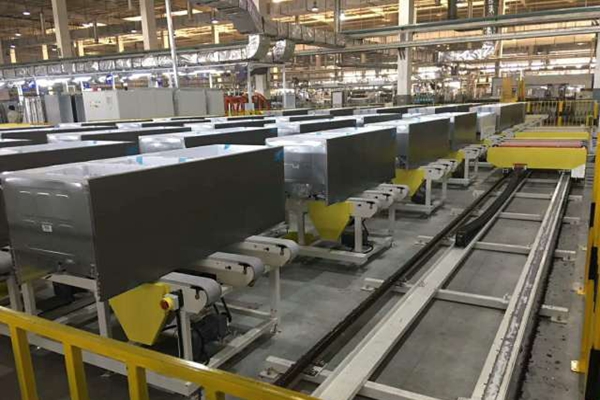
The assembly line uses a pallet-based floor conveyor system for upright refrigerator cabinet production. Unlike overhead hanging systems used for chest freezers, this design uses chain-driven pallets with dedicated fixtures. This approach provides better stability for tall, narrow cabinets during assembly.
Dual-Track Layout Design
The line follows a dual-track layout. A central power-and-free chain conveyor carries product pallets, while parallel roller sections handle empty pallet return and sub-assembly feeding. This closed-loop design maximizes pallet use and saves floor space. The yellow safety guarding along the line meets ISO 13857 standards and OSHA requirements for North American installations.
Custom Product Fixtures
Each product pallet is engineered as a custom fixture. A contoured steel frame cradles the refrigerator cabinet from below, keeping it upright throughout assembly. Fixtures bolt to the pallet base instead of welding, allowing quick changeover when switching between cabinet sizes or door styles.
2. Conveyor System Mechanical Design
The material handling system uses a chain-driven live roller or slat-chain conveyor, depending on load requirements. For refrigerator cabinets, the conveyor typically includes a heavy-duty chain with motor-reducer drive, variable speed control from 0.7 to 2.0 meters per minute, and a welded steel frame with powder coating. Load capacity ranges from 150 to 300 kilograms per pallet, including cabinet and fixtures.
Zone Control and Accumulation
The conveyor divides into process zones with independent stop and start control. Photoelectric sensors at zone boundaries detect pallet presence and communicate with the central PLC via PROFINET or EtherNet/IP. This allows pallet accumulation between stations without stopping the main drive chain, which is important when station cycle times vary due to model mix or manual work.
Auxiliary Transfer Equipment
Auxiliary equipment handles directional changes and buffer needs. This includes 90-degree and 180-degree turntables for line reconfiguration, pneumatic pop-up transfers for diverting pallets to test or rework tracks, and vertical elevators for multi-level layouts. All transfer mechanisms sync with the main conveyor through the same PLC backbone.
3. Product Fixture and Cabinet Handling
During the pre-foam stage, the refrigerator cabinet is relatively fragile. It consists of a thin steel outer shell, typically 0.4 to 0.6 millimeters thick, paired with a vacuum-formed ABS or HIPS inner liner. The fixture must support this structure without causing deformation.
Fixture Design Features
Key fixture features include a bottom support frame made from welded steel with rubber-padded contact points to prevent surface damage. Pneumatically actuated side clamping arms engage after cabinet loading to prevent lateral sway during transport. The open front and rear design leaves the cabinet cavity fully accessible for liner insertion, refrigeration component installation, and foam injection. Quick-release mounting allows fixture changeover in under 15 minutes for model transitions.
Benefits of Upright Orientation
The upright orientation serves several purposes. It enables gravity-assisted inner liner placement, provides natural drainage during foam injection and curing, and positions the compressor compartment at a comfortable working height for final assembly.
4. Core Assembly Process Stations
The line follows a typical upright refrigerator build sequence organized into distinct process zones.
4.1 Cabinet Shell Loading and Liner Insertion
The outer U-shell arrives from the sheet metal forming line. It is loaded onto the fixture, and the vacuum-formed inner liner is inserted from above. This station requires precise alignment. The liner must seat fully into the shell cavity without wrinkles or distortion, since any gap creates a thermal bridge in the finished product. Operators use visual guides and sometimes low-pressure air to float the liner into position.
4.2 Refrigeration System Installation
This is the most technically demanding station. The hermetic refrigeration circuit includes compressor, condenser, evaporator, and capillary tube. All must be installed with leak-tight integrity. The compressor secures to the base pan with rubber isolation grommets and connects to the electrical harness. The condenser mounts against the rear wall, while the evaporator embeds in the inner liner or attaches to the freezer compartment ceiling.
Leak Testing and Refrigerant Charging
Copper refrigerant lines route through the cabinet cavity and join via brazing. Every joint undergoes pressure testing, and higher-spec lines use helium mass spectrometry leak detection. The system evacuates to deep vacuum to remove moisture and non-condensables, then charges with the specified refrigerant mass.
4.3 Polyurethane Foam Injection
Polyurethane rigid foam forms the structural and thermal core of the refrigerator. It injects into the cavity between the outer shell and inner liner, expanding and curing to bond both surfaces into a rigid composite. The foaming station operates as an offline or semi-offline cell with hydraulic clamp fixtures that compress the cabinet during foam rise to control dimensional tolerance.
Process Parameters and Quality Control
Process parameters include a polyol to isocyanate ratio of 100:105 to 100:115 by weight, material temperature of 20 to 25 degrees Celsius, mixing head pressure of 10 to 15 megapascals, and mold temperature of 35 to 45 degrees Celsius. Demold time ranges from 4 to 8 minutes depending on formulation. High-pressure mixing heads produce finer, more uniform cell structure and reduce thermal bridge risks. Target foam density is 35 to 45 kilograms per cubic meter. After demold, the cabinet cures in a heated tunnel or ambient queue before downstream assembly.
4.4 Final Assembly and Functional Test
The foamed cabinet returns to the main line for component installation. Door assembly includes hinge, gasket, and handle fitting, with adjustments for parallel closure and seal compression. Controls and wiring involve thermostat, interior lighting, and power cord installation. Glass shelves, crisper bins, and door racks are then inserted.
Cooling Performance Test
The completed unit enters a Cooling Performance Test station. It energizes and runs under controlled ambient conditions. Acceptance criteria include pull-down time, temperature uniformity across compartments, and energy consumption metering. Units that fail any test divert automatically to a rework loop, with failure data logged against the unit serial number for root-cause analysis.
5. Line Control and Information Systems
A Manufacturing Execution System integrated with the PLC layer manages the assembly line. Each pallet carries a unique RFID or barcode tag that links the physical unit to its digital production record. At each station, the operator scans the tag, and the MES displays correct work instructions, torque specifications, and component part numbers for the specific model. This error-proofing prevents misassembly when multiple SKUs share the same line.
Data Collection and Traceability
Critical process data captures automatically and writes to the unit’s electronic birth certificate. This includes foam injection weight, refrigerant charge mass, vacuum hold time, and pull-down performance. If a field failure occurs months later, the manufacturer can trace the exact production conditions, operator, and component batch. The control architecture typically uses a Mitsubishi or Siemens PLC with distributed I/O modules at each station, communicating over PROFINET or EtherNet/IP.
6. Competitive Positioning for Line Builders
The value proposition extends beyond mechanical fabrication. Core differentiators include process domain expertise in foam thermodynamics, refrigerant brazing metallurgy, and vacuum-formed liner tolerancing. Customers buy the line expecting it to produce certifiable product from day one.
Scalability and Integration
Modular scalability allows extending the line with additional stations or buffer loops as product mix changes. A line configured for 120 units per hour can rebalance for 180 units per hour with targeted upgrades. Integration depth means specifying, procuring, and commissioning subsystems as a single turnkey responsibility. This reduces vendor management burden and eliminates interface risk. Global compliance requires dual certification for CE marking in Europe and UL or CSA compliance in North America.
7. Closing Remarks
The refrigerator cabinet assembly line represents a mature solution for high-volume appliance manufacturing. The pallet-based floor conveyor provides the material handling backbone, while process stations deliver product-specific value through refrigeration installation, foam injection, and functional testing. For line builders, differentiation comes from deepening process knowledge in the line design, ensuring every mechanical specification traces to a validated manufacturing outcome.
Email:yu.yblsx@gmail.com