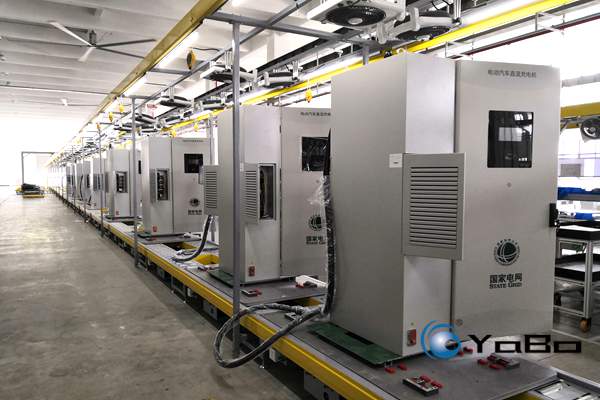
Charging pile assembly line planning: from design to mass production
With the rapid growth of the new energy vehicle market, the demand for charging piles as infrastructure is also rising sharply. For manufacturing companies planning to enter this field, establishing an efficient and reliable charging pile production line is the key to success.
1. Structure and production characteristics of charging piles
The diversity of charging pile products determines that the assembly line needs to have certain flexibility. Depending on the installation scenario and power level, charging piles can be divided into multiple types, but the basic structure is similar:
- AC charging pile (slow charging): The structure is relatively simple and mainly consists of a control module, a metering module and a housing. The production process is relatively simple and there are few assembly links. The cost of a single unit is low and the output demand is large.
- DC charging pile (fast charging): It contains complex components such as power modules, control modules, and cooling systems. The production process is complex and involves special links such as high-pressure testing. Single unit has high value and strict quality requirements.
Characteristics of charging pile production:
- Multiple varieties and small batches: The market demand is diversified and the production line needs to have rapid replacement capabilities.
- Combination of high and low voltage: involves low voltage control and high voltage power, and has special requirements on the production environment.
- The testing process is important: a variety of electrical performance and safety tests are required, and the investment in test equipment accounts for a relatively high proportion.
2. Automated conveying system: application of plate chain lines and roller lines
The automated conveying system is a core part of the charging pile assembly line, which directly affects production efficiency and product quality stability. According to the weight, shape characteristics and production needs of charging piles, plate chain line and roller line are the two most commonly used transportation solutions:
Plate chain conveying line: A continuous conveying surface formed by connecting metal chain plates, suitable for heavier charging pile products (usually more than 50kg).
- Strong carrying capacity, can transport 100-500kg of charging pile shells and finished products.
- Flat countertop for assembly operations during transportation.
- Can realize intermittent exercise and cooperate with rhythmic production.
- Wear resistance, long life, low maintenance costs.
- Suitable for assembly lines for heavy products such as DC charging piles.
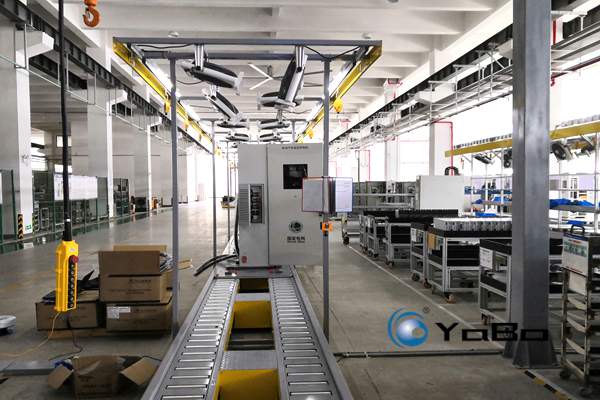
Roller conveying line: consists of a series of parallel arranged rollers. Material transportation is realized through the rotation of the rollers. It is suitable for small and medium-sized charging piles.
- Low friction, low energy consumption and smooth operation.
- Layout design such as steering and diversion can be easily realized.
- Easy to interface with other automation equipment.
- Suitable for the transportation of light products such as AC charging piles.
- It can realize the accumulation function and facilitate buffering between processes.
3. Summary
The planning of the charging pile production line should follow the principles of “moderate automation, focus on flexibility, and ensure quality”, and formulate reasonable plans based on the scale of the enterprise and product positioning.