Low Transformer Efficiency? Choose the Right Automated Line!
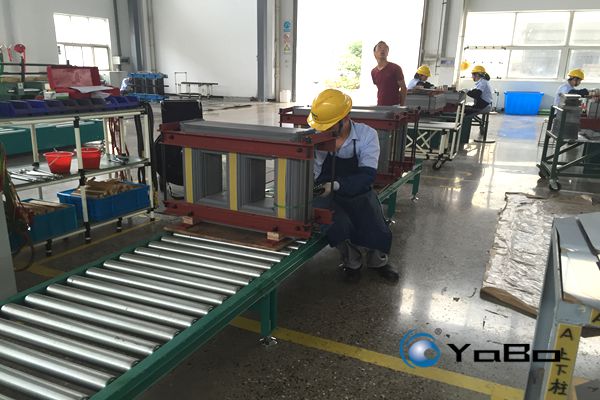
In the power equipment manufacturing industry, transformers are key equipment, and their production quality and efficiency directly affect the stability and economy of the entire power system. As the core material transportation carrier, the roller line runs through the entire process of iron core processing, winding assembly, fuel tank assembly, and finished product inspection by virtue of its strong carrying capacity, stable transportation, and adaptability to heavy/large workpieces, realizing the smooth flow of transformer components and the whole machine.
1. The core positioning of the drum line in the assembly line
The core workpieces in transformer production (silicon steel coils, formed cores, coil windings, oil tanks, and complete assembly parts) generally have the characteristics of “large weight (50kg-10 tons), wide size span (small distribution transformers have a diameter of 0.5 m, large power transformers have a diameter of more than 3m), and the surface needs to be protected (to avoid scratches and collisions).” Traditional transportation methods (such as forklifts and manual hoisting) have problems such as low efficiency, easy damage to workpieces, and poor positioning accuracy. However, the drum line adapts production needs through the following positioning:
- Heavy-duty load-bearing transportation: Thickened steel tube rollers and high-strength brackets are used. A single roller line can carry heavy objects of 5-10 tons/meter, which is suitable for long-distance transfer of complete transformers and heavy components;
- Precise positioning connection: Linkage with PLC control system and servo motor to realize “fixed point docking” of workpieces (positioning error ≤±5mm), meeting the precise docking requirements of robot assembly and automatic detection;
- Flexible adaptation to multiple specifications: Adapt transformer components of different diameters and lengths (such as iron cores and oil tanks of different voltage levels from 10kV to 110kV) through adjustable roller spacing and retractable conveying sections;
- Protective transportation: The surface of the roller is wrapped with rubber/polyurethane material to avoid scratching key parts such as silicon steel sheets, coil insulation layers, and fuel tank shells.
2. Core advantages of transformer assembly lines
Production efficiency has been greatly improved
- The automated assembly line achieves 24-hour uninterrupted production and greatly shortens the production cycle. Data shows that after the adoption of automated assembly lines, the production efficiency of transformers has increased by more than 300% on average, and the order delivery cycle has been shortened by more than 60%. This means that companies can respond to market demand faster and increase customer satisfaction.
Improved product quality stability
- Through precise mechanical control and automated testing, the impact of human factors on product quality is minimized. Statistics show that the pass rate of automated production of transformer products can reach more than 99.5%, which is much higher than the 92-95% of traditional production models. At the same time, the consistency of product performance parameters has also been significantly improved.
Production costs are significantly reduced
- Although the initial investment in automated assembly lines is large, it can significantly reduce production costs in the long run:
- Reduce labor costs by 60-70%, reducing reliance on skilled workers ;Increase material utilization by 15-20%, reducing waste ;Energy consumption is reduced by approximately 25%, in line with the concept of green manufacturing ;Reduced scrap rates, reduced rework and material losses.